Song of Songs 1-4
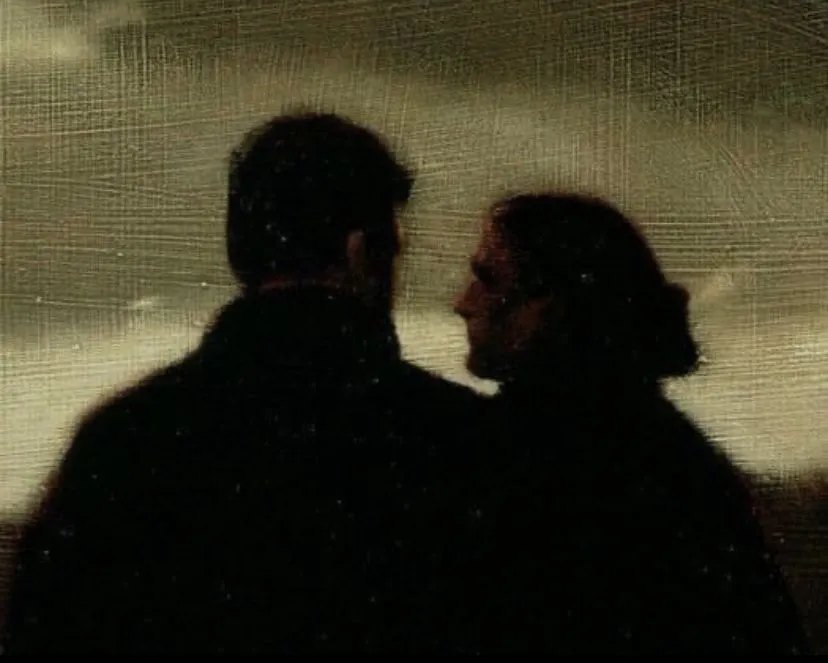
Song of Songs is unlike anything else I have read in the Bible so far. It is filled with vineyards, gardens, perfumes, gazelles, fruit, flowers, and an impressive number of compliments involving farm animals. Everything is poetic, but beneath all the imagery is a picture of love that feels surprisingly different from the way love is often treated now.
The woman begins conscious of how others might see her. She has spent so much time working beneath the sun that her skin has become dark, and she notices the women of Jerusalem looking at her.
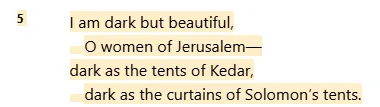
She knows that she is beautiful, but there is still something defensive in the way she says it. She seems to be anticipating judgment before anyone can say anything. Then her beloved looks at her and responds as though her insecurity makes no sense to him. He calls her the most beautiful woman of all. Later, when she describes herself as one flower among many, he tells her that she is a lily among thistles.

It is basically his way of saying, You may think you are ordinary, but you do not look ordinary to me.
But what I love is that she does not only receive his reassurance. She gives something back.
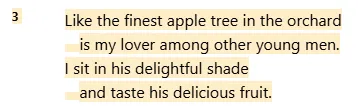
She does not simply tell him that he is handsome. She tells him how his presence makes her feel. He gives her shade. She can rest beside him. His love is refreshing, safe, and pleasurable. He tells her that she is beautiful, and she tells him that his presence gives her somewhere to rest.
Their love continues like this throughout the book. She looks for him; he comes looking for her. He praises her; she praises him. He invites her; she responds. She invites him; he responds. Each person’s effort is met by the other person’s effort.
I think this stood out to me because modern love sometimes feels like a game of determining who can care less. Whoever replies first is too eager. Whoever shows more affection has lost. Whoever admits that something hurt them is “doing too much.” People hide how they feel because vulnerability is treated as surrendering power.
But neither lover in Song of Songs wins by being indifferent.
Their love develops through reciprocity. One person’s vulnerability is not used as leverage; it is answered with more vulnerability. Neither of them seems embarrassed to be the one who loves openly. They keep giving the other person something safe to respond to.
There is also a moment when they are together outside, surrounded only by grass and trees.
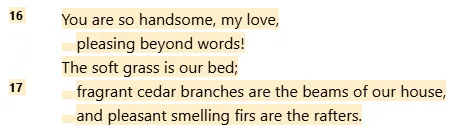
They do not need a palace or a perfectly arranged date to feel romantic. The grass becomes their bed, and the trees become the beams of their house. Their affection transforms the place around them. They do not depend upon the environment to create romance for them; they bring romance into the environment.
It made me think about how often we believe love needs a special occasion to feel alive. We plan expensive dinners, vacations, anniversaries, and grand gestures to “bring back the spark.” None of those things are wrong. Song of Songs certainly appreciates banquets, jewelry, perfume, and a wildly extravagant wedding procession. But beautiful settings can express love; they cannot manufacture it.
Most of married life does not happen at a candlelit dinner. It happens on ordinary Tuesdays. It happens while buying groceries, cleaning the house, sitting in traffic, deciding what to eat, or lying beside each other while doing completely separate things. If love only feels present when something exciting is happening, then it will be absent for most of our lives.
The lovers remind me that home is not only a beautiful place two people enter. Sometimes home is something their love creates between them. The truest kind of romance may simply be: Nothing special is happening, but being beside you still feels special.
Yet Song of Songs does not pretend that love is only comforting. The woman repeatedly warns the women of Jerusalem:
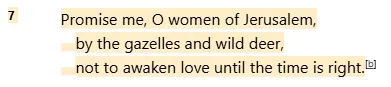
At first, I thought this was mainly a warning against awakening sexual desire too early. I still think that is part of it, but after reading about how overwhelmed she becomes by love, I think the warning reaches further.
Love can feel overwhelmingly good, but it can also feel overwhelmingly terrible.
I know what it is like to love someone and then wonder whether their feelings have changed. Did I open myself too much? Did I become unbearable? Why does he feel distant? Does he still love me the same way? When the woman searches for her beloved at night and cannot find him, I understand the emotional anxiety of that scene even if my experience was not literally the same.

Once we love someone, their distance affects us differently. We have given them the ability to reassure us deeply, but we have also become vulnerable to being hurt by them. When she finally finds him, she catches him and refuses to let him go. I can feel the relief in that moment: You are still here. I was not foolish for believing that this mattered.
When we are younger, we can be so eager to experience love without understanding everything love can require from us. We want the butterflies, attention, affection, constant messages, and the feeling of being chosen. We do not always realize that attachment can also bring uncertainty, disappointment, jealousy, grief, and heartbreak.
Not awakening love until it is ready does not mean waiting until we are so mature that love can no longer hurt us. Loving anyone will always make us vulnerable. I think readiness means becoming capable of loving without losing our entire identity, communicating instead of manipulating, recognizing unhealthy treatment, and handling another person’s heart with care.
It also means allowing God to prepare us, not only asking Him to prepare the right person.
It is easy to pray, God, give me someone patient, faithful, communicative, forgiving, and emotionally mature. But am I becoming patient, faithful, communicative, forgiving, and emotionally mature? Am I prepared to listen, apologize, repair, and remain humble when love becomes inconvenient?
The “little foxes” made me think about this too.
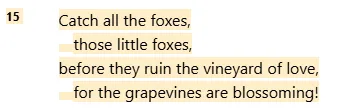
A small fox may not appear dangerous, but it can destroy a vineyard while its fruit is still developing. Relationships can be damaged in the same way, not always by one dramatic betrayal, but by small things repeatedly left unaddressed. Resentment. Pride. Dismissive jokes. Unspoken expectations. Dishonesty. Neglect. Allowing outsiders into places that should remain protected. Refusing to apologize because being right feels more important than being close.
Saying, “Can we talk about what happened?” is not doing too much. It means the relationship matters enough to protect. The person who initiates repair has not lost. If both people compete to care less, eventually they may succeed, and there will be almost nothing left between them to save.
Healthy love does not mean never encountering foxes. It means both people understand that they are protecting the same vineyard.
Then chapter 3 moves from the woman searching alone in the darkness to an enormous public wedding procession. Her private uncertainty becomes visible commitment. The relationship is no longer hidden or undefined. It is recognized, protected, and celebrated.
There is something deeply reassuring about a love that is not ashamed to claim you openly. Public displays alone do not prove that someone loves us, a person can post us everywhere and still mistreat us privately. But healthy commitment brings someone into the reality of our life. It says, I am not keeping you in an undefined corner. I am willing to be known as the person who chose you.
Finally, chapter 4 feels like all their longing, restraint, reassurance, and waiting coming into fruition. He looks at his bride and admires her completely.

He does not rush toward her body without seeing the person before him. He notices her eyes, hair, smile, dignity, voice, fragrance, affection, and beauty. His desire is physical, but it does not reduce her to what her body can provide.
I think that is the difference between sexual desire and lust. Desire says, I want you because I love and delight in you as a whole person. Lust says, I want what your body can give me. One treasures the person; the other consumes them.
Her body and sexuality are described as a locked garden, a secluded spring, and a hidden fountain. Her garden is beautiful and desired, but it is not public property. It remains hers to protect and hers to open willingly.
Then, after he has expressed his love and desire, she responds:
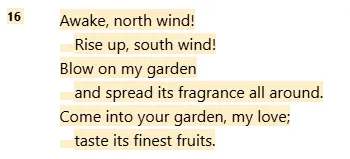
Even though they are bride and bridegroom, he does not simply take what he believes marriage entitles him to have. He expresses desire, and she answers with desire and invitation. Marriage does not erase the need for consent. Their intimacy is beautiful because it is mutual: desire meets desire, vulnerability meets safety, and invitation meets loving response.
She is not saying only, You may have my body. She is saying, I love and trust you so deeply that I want you to know and receive all of me.
I did not wait until marriage myself, so I do not know what it feels like for that first physical union to carry the full weight of years of restraint and anticipation. But reading Song of Songs helps me understand why waiting can matter. Sex creates vulnerability and can deepen attachment. If we give that intimacy believing it expresses mutual love, only to discover that the other person wanted access without commitment, the wound can reach much deeper than physical disappointment. We may begin wondering whether we were ever truly known or whether we were only desired temporarily.
But I also do not believe failing to wait means someone has permanently given themselves away or become less worthy. God’s grace does not forgive us only to leave us forever outside the beauty He intended. Even within marriage, deeper emotional and sexual intimacy can still be cultivated. We can learn to see one another more attentively, express admiration more openly, create greater safety, and make intimacy something mutually offered rather than routinely expected.
Song of Songs has shown me that love is not proved by who can remain the least affected. Love is allowing yourself to be seen and treating what another person reveals as sacred. It is reassurance returned with reassurance. It is making a home together on an ordinary patch of grass. It is catching the little foxes before resentment grows. It is waiting when love is not ready and responding courageously when its season arrives. It is choosing someone privately and honoring that choice publicly. It is desire that does not take, but treasures, waits, and receives.
Love does not ask, Who cares more?
Love says, We both do. Now let us protect what is growing between us.